This is the same as Lesson 2, but with more information. You’ll want to read this to gain more knowledge

Chapter 3B: Neurobiological Dysregulation, Functional Behavior Assessment, and Proactive De-escalation Frameworks

3.1 The Neurobiology of Stress, Triggers, and Nervous System Overload

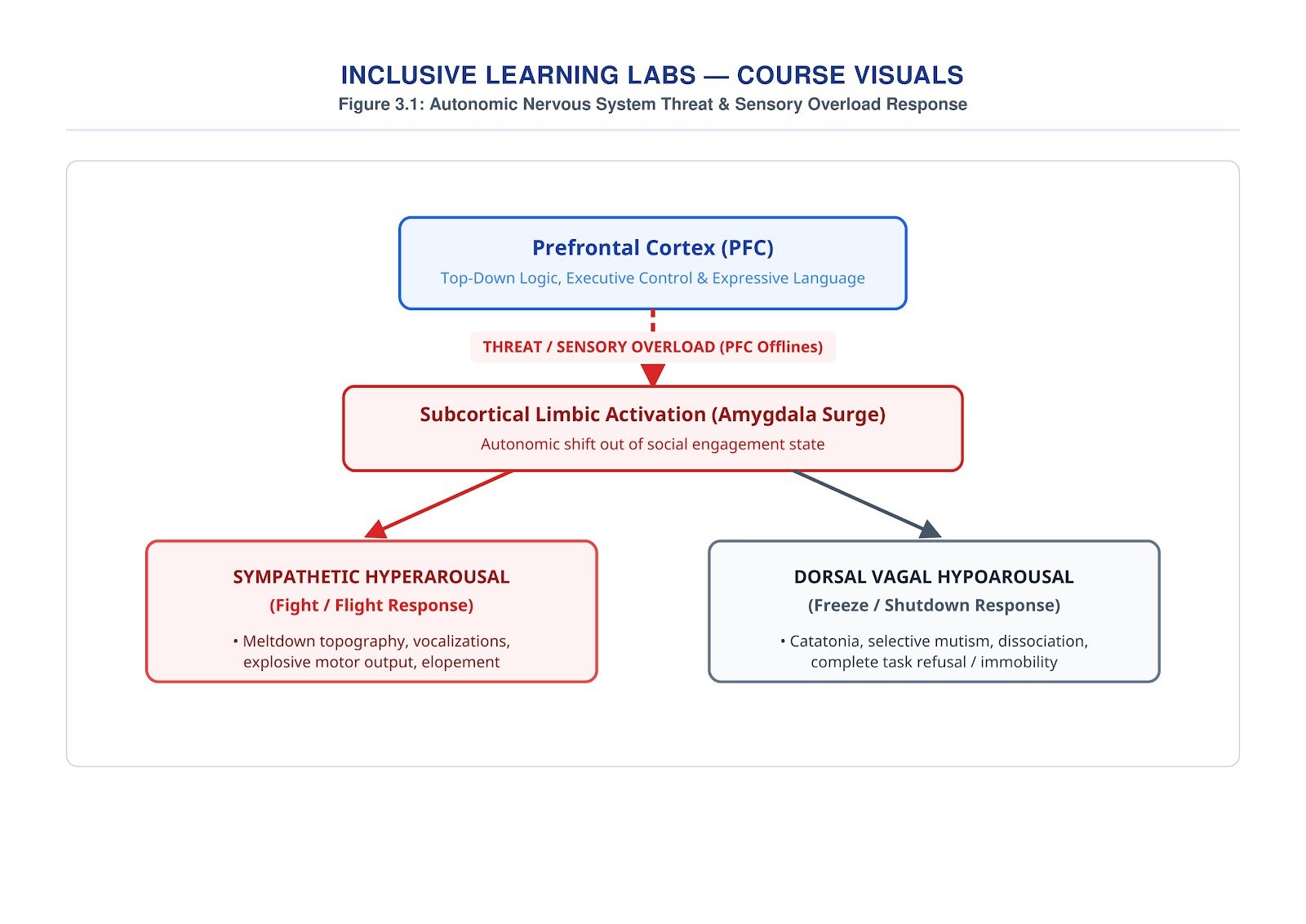
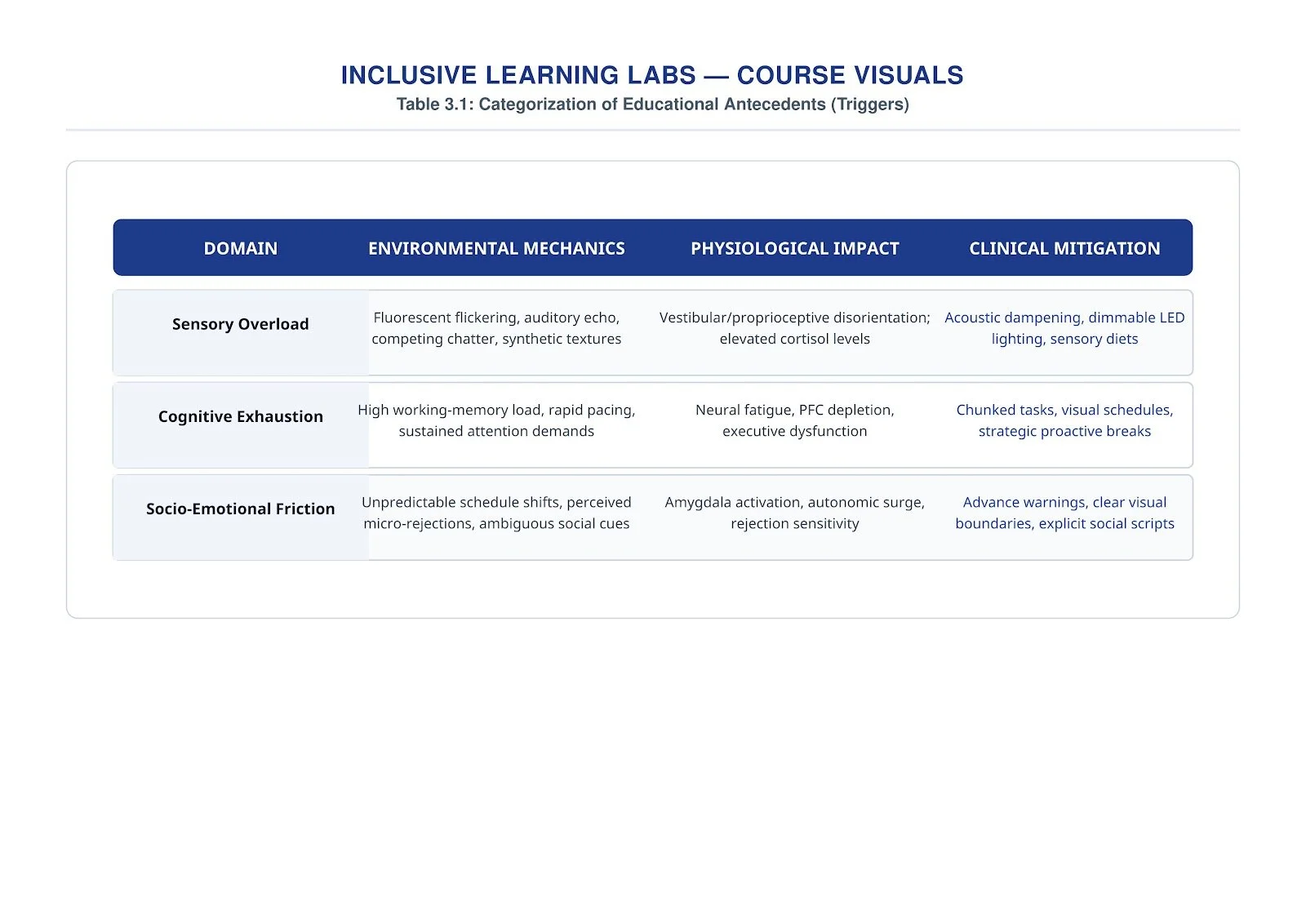
To effectively prevent and address challenging behaviors in an inclusive classroom, educators must understand the underlying neurobiology of stress. A trigger is an antecedent event, environmental factor, or internal stimulus that threatens an individual's neuroceptive safety, causing the autonomic nervous system (ANS) to shift out of a social engagement state.

Grounded in Stephen Porges' Polyvagal Theory, the human nervous system continuously evaluates environmental cues for safety or danger (neuroception). When sensory inputs or cognitive demands exceed a student's coping capacity, the Prefrontal Cortex (PFC)—responsible for executive function, impulse control, and expressive language—experiences a functional shutdown ("offlining"). Control shifts to the subcortical structures of the Limbic System, activating one of two primary survival responses:

  1. Sympathetic Hyperarousal (Flight/Fight): Characterized by motor agitation, vocalization, elopement, or physical aggression.

  2. Dorsal Vagal Hypoarousal (Freeze/Fawn): Characterized by sudden behavioral shutdown, selective mutism, dissociation, or catatonic immobility (frequently misdiagnosed as intentional non-compliance).

3.2 Differential Diagnosis: Operant Tantrums vs. Neurological Meltdowns

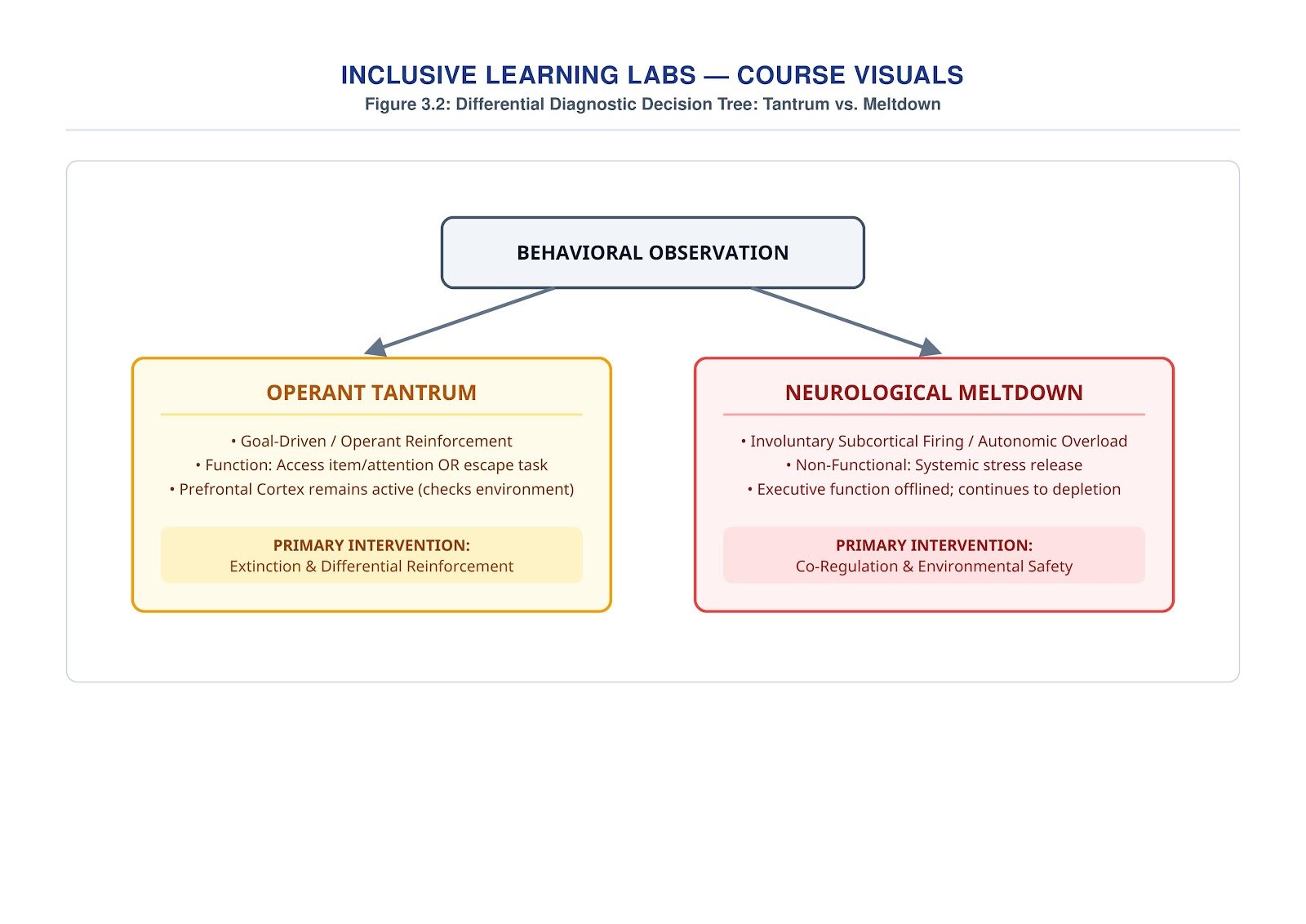
A critical competency for the inclusive educator is differentiating between operant (function-driven) behavior and neurobiological dysregulation. Treating a meltdown as a tantrum (or vice versa) can exacerbate behavioral escalation and cause secondary trauma.

1. Operant Tantrums (Operant Conditioning Framework)

  • Etiology: Driven by learned contingencies of reinforcement (operant behavior).

  • Function: Explicitly functional—designed to secure access to a tangible item, obtain social attention, or escape/avoid a low-preference demand.

  • Characteristics: The student maintains executive control, actively monitors adult reactions, and adjusts the behavior based on feedback. The behavior immediately abates if the target reinforcer is delivered.

2. Neurological Meltdowns (Autonomic Dysregulation)

  • Etiology: Driven by autonomic overload and involuntary subcortical firing.

  • Function: Non-functional; the behavior is an uncontrollable physiological release of systemic stress.

  • Characteristics: The student loses executive control and perceptual awareness. The behavior continues regardless of environmental feedback or access to preferred items, ending only when the nervous system reaches physiological depletion.

3.3 Clinical De-escalation Protocol: The Co-Regulation Continuum

During a true neurological meltdown, traditional behavioral techniques (such as verbal reasoning, token economies, or loss of privileges) fail because the student's language processing centers (Broca's and Wernicke's areas) are compromised. Educators must shift from instruction to co-regulation.

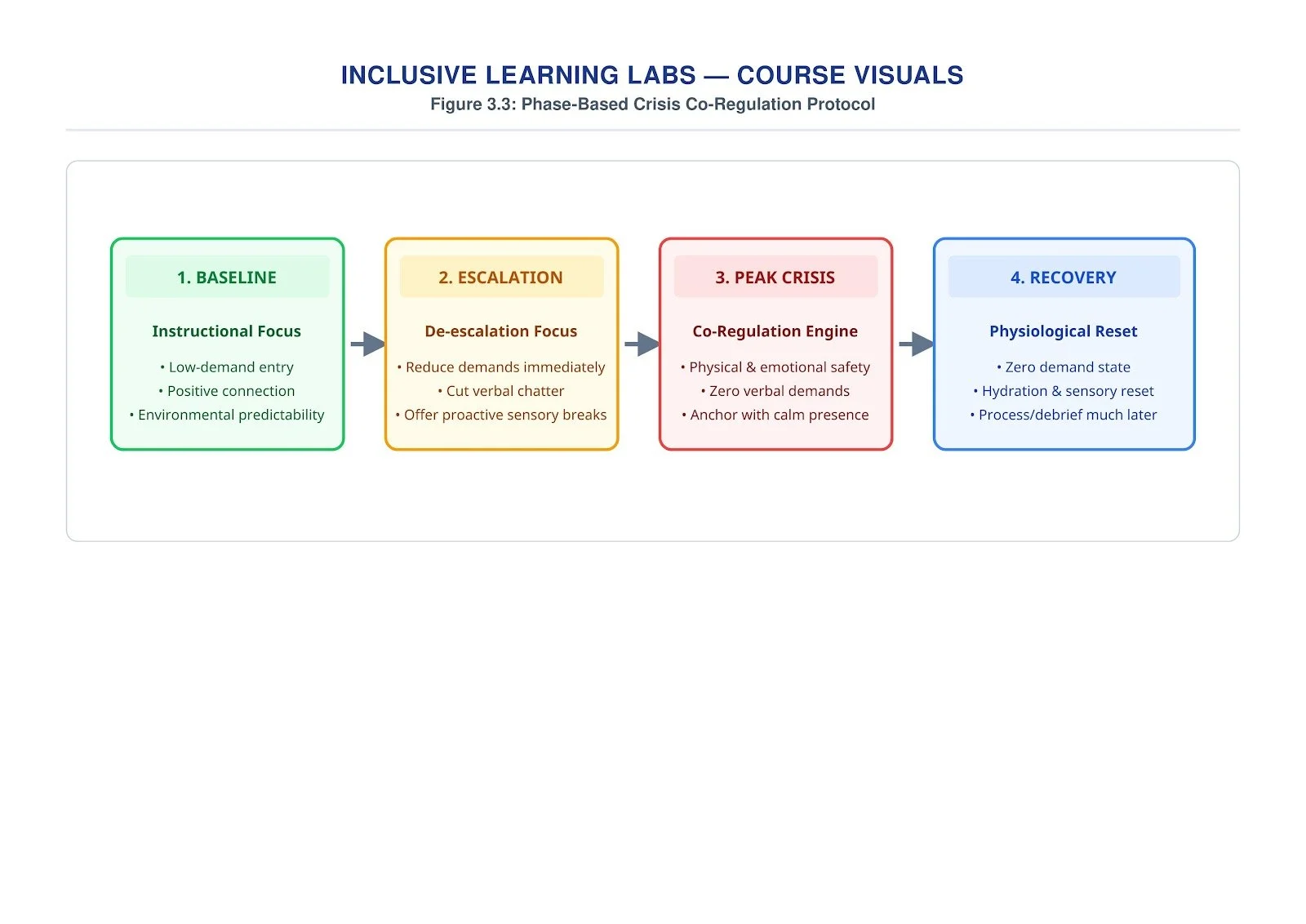
The Phase-Based Crisis Framework

1. Phase 1: Escalation (Rumbling Phase)

  • Clinical Presentation: Pacing, vocal pitch alterations, physical restlessness, peripheral gaze avoidance.

  • Action Protocol: Immediate demand reduction. Activate low-arousal presence. Implement sensory accommodations (e.g., noise-canceling headphones, weighted lap pads) without requiring verbal requests from the student.

2. Phase 2: Peak Crisis (The Meltdown)

  • Clinical Presentation: Explosive physical output, SIB (self-injurious behavior), elopement, loss of linguistic comprehension.

  • Action Protocol:

    • Co-Regulation Engine: The educator's nervous system serves as an external regulator. Maintain a lower heart rate, calm posture, and reduced vocal volume.

    • Linguistic Deprivation Protocol: Limit verbal input to single-word, high-predictability cues (e.g., "Safe," "Here"). Avoid asking "why" or offering multi-step choices.

    • Environmental Safety Containment: Remove hazards from the immediate area rather than placing physical demands on the student. Avoid trapping or crowding the student unless physical safety mandates intervention.

3. Phase 3: Post-Ictal Recovery (The Vulnerable Window)

  • Clinical Presentation: Emotional fatigue, tearfulness, somatic exhaustion, shame, flat affect.

  • Action Protocol: Zero demand state. Offer basic physiological needs (hydration, quiet sensory reset). Do not immediately process or debrief the incident; the nervous system requires hours to return to physiological baseline.

3.4 Functional Behavior Assessments (FBA) & Behavior Intervention Plans (BIPs)

When a student demonstrates persistent behavioral patterns that interfere with learning, federal mandate (IDEA) and best practice require transitioning from informal management to a formal Behavior Intervention Plan (BIP) informed by a comprehensive Functional Behavior Assessment (FBA).

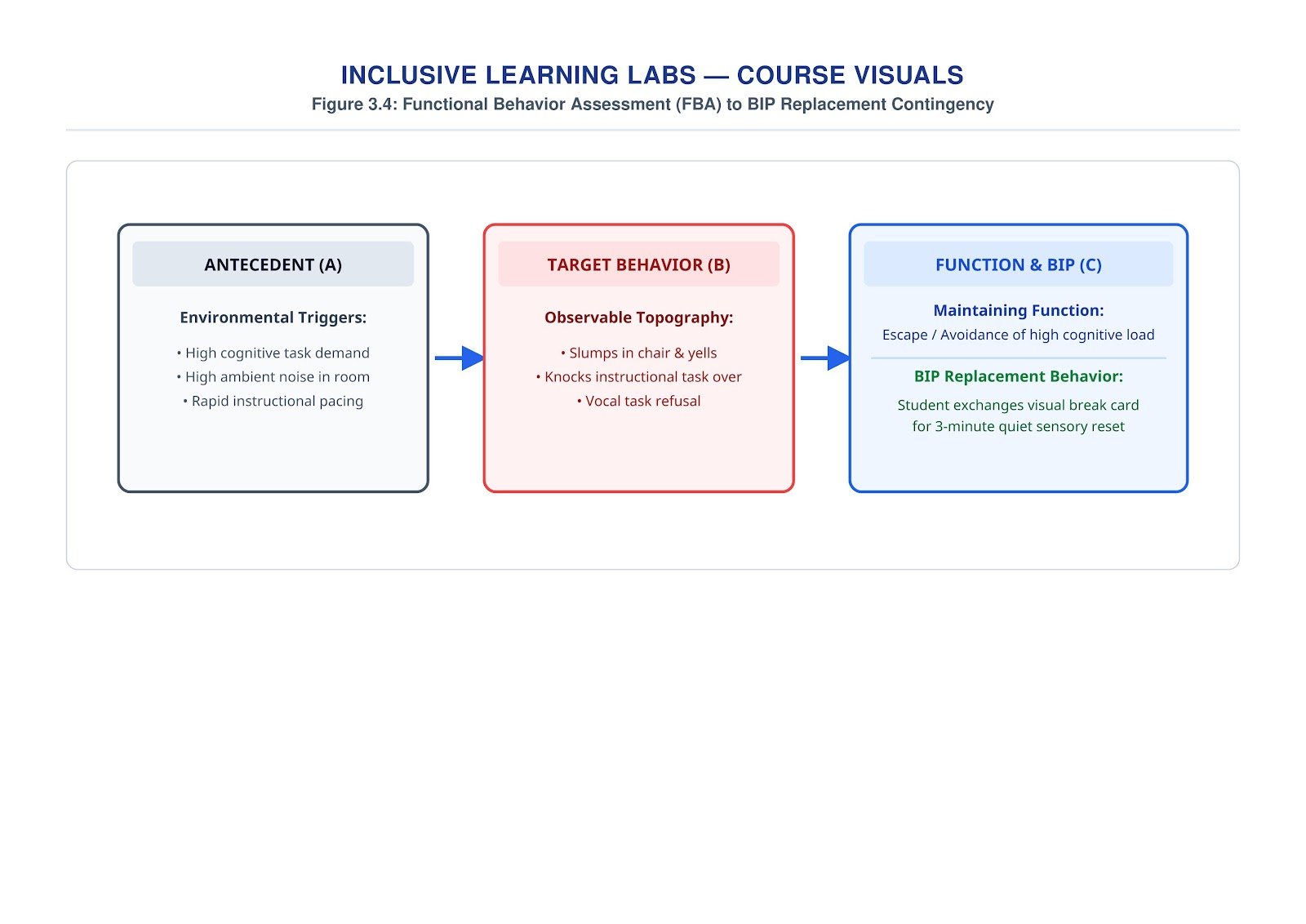
The ABC Contingency Mapping in FBAs

An FBA identifies the environmental variable maintainers of a behavior by dissecting the three-term contingency:

Antecedent (A) ———————> Behavior (B) ————————> Consequence (C)

  1. Antecedents: Identifying environmental triggers and setting events (e.g., sleep disruption, medication changes).

  2. Behavior Topography: Defining the target behavior in operational, observable, and measurable terms (e.g., "student throws chair" vs. "student acts aggressively").

  3. Maintaining Consequences: Determining the underlying function of the behavior:

    • Social Positive Reinforcement: Access to attention/items.

    • Social Negative Reinforcement: Escape/avoidance of tasks/interactions.

    • Automatic/Sensory Reinforcement: Internal sensory stimulation or pain attenuation.
Key Components of a Clinical BIP

A successful BIP replaces guesswork with a standardized, legally binding framework:

  • Proactive Antecedent Modifications: Changes to the environment to prevent the behavior from occurring (e.g., visual schedules, adjusted assignment length).

  • Replacement Behavior Instruction: Teaching a functionally equivalent, socially valid alternative behavior (e.g., teaching a student to use a break card instead of eloping to escape a difficult task).

  • Consequence Strategies: Protocols for reinforcing the replacement behavior while ensuring the problem behavior no longer accesses its maintaining reinforcer (extinction).

  • 3.5 Professional Ethics, Crisis Protocols, and Interdisciplinary Collaboration

    When faced with unprecedented or high-risk behaviors that lie beyond a teacher's current repertoire, educators must operate within strict professional ethical boundaries.

    1. The Cascade of Systemic Support

    When classroom-level strategies fail, educators should systematically escalate support requests:

    • Tier 1: Classroom-based universal supports and low-level environmental modifications.

    • Tier 2: Consultation with internal specialists (Special Education Resource Teachers, School Psychologists, Speech-Language Pathologists).

    • Tier 3: Formal multidisciplinary crisis intervention teams, BCBA (Board Certified Behavior Analyst) functional assessments, and district-level support services.

    2. Ethical Interdisciplinary Collaboration

    When consulting external resources, families, and allied health professionals, educators must maintain fidelity to evidence-based practices while respecting the limits of their professional scope. Collaborative reflection with parents should focus on pattern identification across settings rather than shifting blame, using home observations to inform classroom modifications.