Mastering School Transitions: Turning Daily Chaos into Calm
Why Transitions are Universal Triggers
Transitions force a student’s brain to perform four massive tasks all at once:
Stop a task they are currently engaged in (often stopping a high-interest activity).
Shift their cognitive attention to a brand-new set of rules and expectations.
Process new sensory environments (e.g., leaving a quiet, dim classroom to enter a bright, echoing hallway or cafeteria).
Self-regulate through the anxiety of the unknown (unstructured spaces like recess or lunch).
For neurodivergent students or those with sensory processing differences, this sudden shift can feel like a threat to their safety. When the brain feels threatened or overwhelmed, the nervous system bypasses logical thinking and goes straight into fight, flight, or freeze. Preventing dysregulation during transitions isn't about enforcing compliance; it's about providing the predictable scaffolds their brains need to feel safe.
Actionable Strategies for Navigating the "Grey Areas"
1. Simplify Cognitive Load with "First / Then" Frameworks
When a child is transitioning, multi-step directions get lost in translation. Their brain simply cannot process a long list of commands.
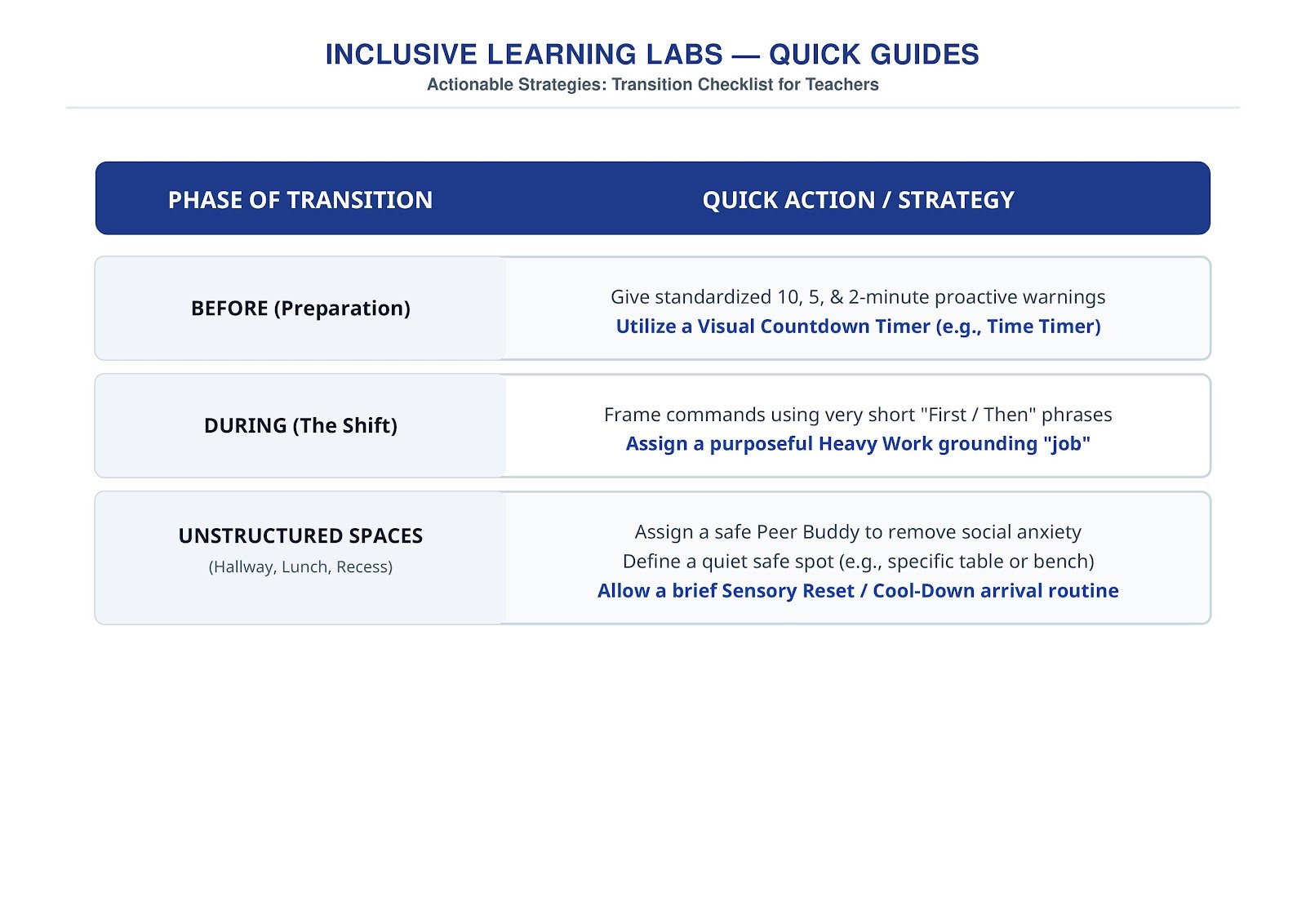
How it works: Reduce your language to the absolute minimum. Frame the transition as two distinct steps using a Visual First/Then Board or clear verbal statement.
Example: Instead of saying, "Okay everyone, clean up your desk, put your pencils in the box, get your coats on, and get ready for recess," say:
"First: Put math book in desk. Then: Line up."
Why it works: It removes the guesswork and lowers anxiety by showing the student exactly what needs to happen right now and what immediate reward or step comes next.
2. Make Time Concrete with Visual Countdown Timers
Time is an abstract idea. Telling a student "We are leaving in 5 minutes" requires them to understand time management and track time internally—skills that are still developing in young children and often impaired in neurodivergent learners.
How it works: Use a visual countdown clock (like a Time Timer) where a red disk vanishes as time ticks down.
The Strategy:
Combine the visual timer with proactive auditory warnings at the 10-minute, 5-minute, and 2-minute marks.
For students who struggle even with timers, give them an active role: "Can you come push the button to start our 5-minute transition timer?"
Why it works: It turns an invisible concept into something tangible. The child can literally see time disappearing, eliminating the feeling that a transition was "sudden" or unfair.
3. Use "Heavy Work" to Ground the Nervous System
Moving through busy hallways or moving between rooms can cause a sensory overload or a spike in physical restlessness.
How it works: Give the student a purposeful physical task that engages their proprioceptive system (the sensory system in our muscles and joints that tells us where our body is in space).
Practical "Jobs":
Carrying a weighted tote bag with books to the main office.
Pushing a heavy library cart down the hall.
Holding the door open for the class (providing isometric muscle resistance).
Carrying the teacher’s heavy clipboard or container.
Why it works: Deep pressure input from "heavy work" releases serotonin in the brain, sending organizing, calming signals directly to a hyperactive or anxious nervous system.
4. Create Safe Anchors in Unstructured Spaces (Lunch & Recess)
Spaces like the cafeteria, playground, and hallway are "unstructured grey areas." They lack clear boundaries, have unpredictable noise levels, and require complex social navigation. This is where most behavioral meltdowns occur.
How it works: Build predictable social and physical anchors before entering the space.
The Strategy:
Peer Buddy System: Pair the student with a rotating, compassionate peer buddy for walking in the hallway, finding a seat in the cafeteria, or initiating a playground game.
Defined Spaces: Designate a specific "safe table" or a designated quiet zone on the playground (like a bench near the teacher on duty) where the student knows they can go if sensory overload strikes.
Why it works: It reduces social isolation and removes the panic of having to make dozens of unstructured decisions in a loud, chaotic environment.
5. Establish a Transition "Cool-Down" Arrival Routine
We often focus on leaving an activity, but arriving at the next destination is just as critical. Expecting a student to walk in from a noisy recess and immediately sit down to do silent reading is unrealistic.