A Teacher’s Practical Guide to Classroom Sensory Tools
Understanding Sensory Integration in the Classroom
Every student’s nervous system processes environmental stimuli differently. Some children are sensory seekers (their brains need more input to stay alert and focused), while others are sensory avoiders (their brains quickly become overwhelmed by light, sound, or movement).
Sensory tools are designed to deliver targeted input to two core hidden senses:
Proprioceptive Input (Deep Pressure): Gives the brain awareness of where the body is in space, which has a deeply grounding and calming effect.
Vestibular Input (Movement & Balance): Stimulates the inner ear fluid through swinging, rocking, or bouncing, helping to regulate alertness and stress.
When integrated correctly, sensory tools proactively prevent meltdowns and keep students ready to learn.
Breakdown of Key Sensory Tools & Implementation Strategies
1. Sensory Swings
The Sensory Input: Deep vestibular movement (swinging, spinning, or swaying) paired with cocoon-like deep pressure.
Why It Works: Rhythmic swinging calms an overstimulated nervous system, while fast or spinning movement can help wake up a lethargic, under-aroused student.
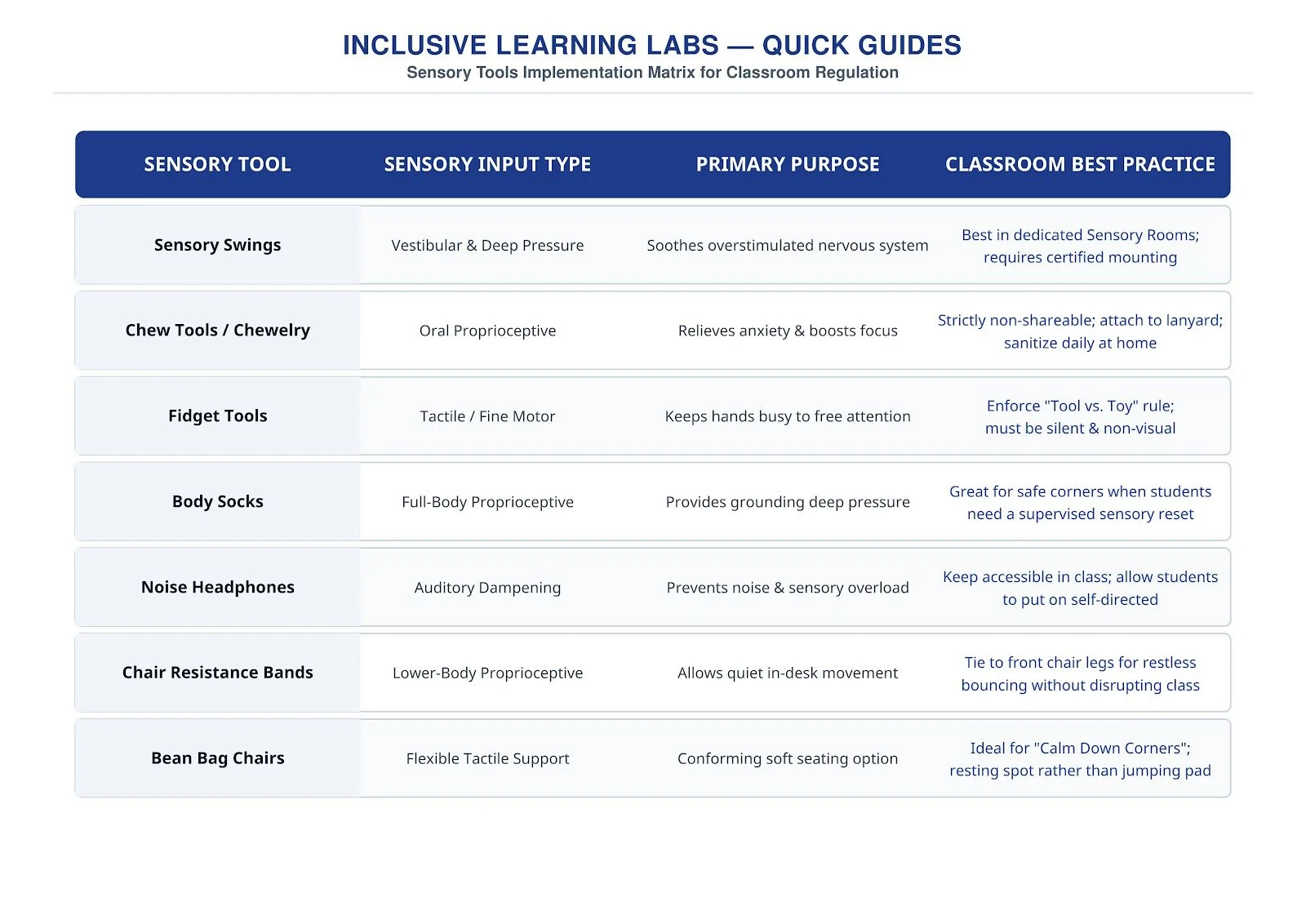
Best Practices: Because they require certified structural mounting and safe clearance space, swings belong in a dedicated Sensory Room or OT clinic rather than a standard classroom. Always supervise use and set 5- to 10-minute timers so every student gets equal access.
[Video Placeholder: Proper Use and Safety Guidelines for Classroom Sensory Swings]
2. Chewable Tools ("Chewelry")
The Sensory Input: Oral proprioceptive input through rhythmic jaw compression.
Why It Works: Chewing is one of the most powerful self-regulating actions humans have (it’s why adults chew gum or pen caps when stressed). It releases calming brain chemicals and helps improve sustained focus.
Best Practices:
Hygiene is Priority #1: Chewelry must be tied to a breakaway lanyard or clipped to a shirt so it doesn't fall on the floor.
Ownership: These are strictly non-shareable. Send them home daily for sanitizing by parents, or sanitize them in-school with medical-grade wipes.
[Video Placeholder: How Oral Sensory Tools Improve Focus and Reduce Anxiety]
3. Fidget Tools (Tangles, Pop-Its, Stress Balls)
The Sensory Input: Tactile and fine-motor engagement.
Why It Works: Occupying a student’s hands gives the "restless" part of their brain something non-taxing to do, freeing up their central cognitive focus to listen to instruction.
Best Practices:
Tool vs. Toy Rule: Explicitly teach: "A tool helps your brain listen to me. A toy takes your eyes away from me."
Selection: Choose silent, non-visual options (e.g., marble-mesh sleeves or silent textured rings) so they do not distract neighboring students.
[Video Placeholder: Selecting Effective Fidget Tools vs. Distracting Toys]
4. Body Socks
The Sensory Input: Full-body proprioceptive resistance (deep pressure stretching).
Why It Works: A stretchy Lycra bag acts as a comforting "hug." It provides immediate feedback to the body's joints and muscles, helping children feel secure, grounded, and physically contained when their emotions feel out of control.
Best Practices: Use these in quiet, padded corners of the room or safe spaces. They are ideal for children who feel exposed or overwhelmed and need to "hide" while remaining completely visible and safe to the teacher.
[Video Placeholder: De-Escalation Techniques Using Body Socks in Safe Spaces]
5. Noise-Canceling Headphones
The Sensory Input: Auditory dampening.
Why It Works: Cuts out high-frequency ambient noise (buzzing lights, hallway echoes, side chatter) without completely blocking a teacher’s direct voice.
Best Practices:
Promote Autonomy: Store 3–4 pairs in an easily accessible basket. Train students to put them on independently during loud transitions, assemblies, or partner work without needing to ask for permission first.
[Video Placeholder: Introducing Noise-Canceling Headphones to the Whole Class]
6. Desk Chair Resistance Bands (Therabands)
The Sensory Input: Heavy-duty proprioceptive leg resistance.
Why It Works: Thick rubber bands looped around the front legs of a desk chair allow fidgety students to bounce their feet or push back with their shins quietly.
Best Practices: Excellent for learners with ADHD or high physical energy. It lets them expend physical energy right at their desk without disrupting instruction or standing up.
[Video Placeholder: Installing and Maintaining Chair Resistance Bands]
7. Bean Bag Chairs
The Sensory Input: Moldable tactile and proprioceptive support.
Why It Works: Unlike hard plastic chairs, a bean bag conforms to the student's body shape, distributing their weight evenly and reducing physical fatigue during reading or cool-down periods.
Best Practices: Place bean bags in a designated "Calm Down Corner" or class library. Set clear rules that they are resting spaces, not launching pads for jumping.
[Video Placeholder: Setting Up an Effective Calm Down Corner with Soft Seating]
Sensory Tools Quick Reference Guide